Google’s coding agents now /swarm for one developer. Cursor’s go multiplayer so teammates’ agents can talk.
Coding agents are pretty good at working in parallel: one writes a new API endpoint, another updates the tests, while
Coding agents are pretty good at working in parallel: one writes a new API endpoint, another updates the tests, while
Cybercriminals using agentic pen-testing tools is a proverbial genie out of the bottle at this point, so enterprises need to get a defense plan in place right away.
The rise of agentic AI systems is giving Kubernetes, long valued for its reliability and predictability, an unexpected second act. As AI spending shifts from training models toward serving them and running agents, the open-source community is developing tools to handle the growing volume of inference requests. The orchestration platform was built from the start
At Block Builderlab Launch Event 2026, AI agents moved out of single-player chat windows and into shared workspaces. There they work beside people as named, auditable members of the team. Block Inc. built these tools to run itself as an intelligence company, and it is now offering them to other businesses, building on Buzz, its
Katerina Tikhonova, Vladimir Putin’s younger daughter, has had a son named Adrian, according to the news outlet Agentstvo, citing leaked civil registry records.
Agentic workloads are pushing Kubernetes into territory its creators never planned for. Agents generate untrusted code on the fly, sit idle for long stretches and churn through pods at a pace that strains the orchestrator’s control plane. Cloud providers are now rethinking how general-purpose a cluster should be. Google LLC’s answer is to stop treating
Built primarily on OpenAI models, Amplitude’s proactive product agent, Wave, identifies what to build, helps teams ship changes with coding agents, and measures the impact.
Built primarily on OpenAI models, Amplitude’s proactive product agent, Wave, identifies what to build, helps teams ship changes with coding agents, and measures the impact.
Google's Gemini 4 Hydrogen replaces the Flash series, but benchmarks suggest it also makes the pricier Argon obsolete. On the independent Artificial Analysis Intelligence Index, Hydrogen nearly matches Claude Sonnet 5.5 for less money but costs about 2.5 times more per task than GPT-6.1 Sol and still falls short on agentic coding. The article Google's Gemini 4 Hydrogen outscores the bigger Argon just four weeks after its launch appeared first on The Decoder.
The early Black Friday sales are now live at Amazon, Best Buy, and Walmart, and so are today’s best Google Play app and game deals: Agent A: A puzzle in disguise, Swim Out, Potion Permit, Burst Busters: Action Survival, The Mutiny, Stop Santa: Tower Defense, KORG Kaossilator for Android, and more. Just be sure to scope out the ongoing all-time low on the Google Home Speaker, the very first deals on the new new Samsung Galaxy SmartTag 3, and the now available Google Pixel Tag…
Armed with a team of AI agents, Google researcher Pietro Miotti claimed earlier this week to have discovered a potentially unmapped Maya site in Mexico. There was just one problem: The site had already been discovered and was published in an academic journal last year. The incident, which sparked criticism among archeologists online, underscores a
“Sharing account credentials with personal, third-party, AI assistants can expose sensitive information, and actions taken by these tools may result in unintended purchases" and more, United Airlines said.
Nectar's new AI agent automates influencer marketing, helping brands discover creators, manage outreach and partnerships, and track campaign results.
Applying machine learning systems to new domains introduces bottlenecks in both labeled data acquisition and manual pipeline engineering. While recent MLE agents show promise in automating pipeline design, they have been studied almost exclusively in fully supervised settings, leaving them untested in realistic regimes where labeled data is scarce but unlabeled data is abundant. In this work, we introduce Agentic Semi-Supervised Learning (AgentSSL), framing SSL as a program…
Coding agents tackle successive tasks on an evolving repository, carrying forward edits and writing memory before the next task is known. Selecting memory for unknown next tasks requires balancing future usefulness against the costs of writing and reading it. The actor must also decide when acting on available memory saves effort as the task unfolds. We introduce Coding-Repository Memory (CoReMem), a cost-internalizing framework that guides memory design and actor adaptation…
On-device inference requires kernels that make effective use of local accelerators. Efficient training and evaluation of models that generate Apple Metal kernels benefit from native macOS tools and concurrent agent sessions. These sessions alternate between model requests, development commands, and GPU execution, leaving GPU capacity idle for much of a rollout. We present Metal Sandbox, infrastructure that combines restricted per-instance file access, native command…
We introduce GeoWorld, a controllable and continuously evolving geographic environment platform for LLM agents, and LiveGeo, a benchmark for evaluating reliable decision-making in real-world geographic environments using GeoWorld. Unlike existing evaluations that largely reason and plan over fixed geographic states, GeoWorld is grounded in real-world geographic structure and allows external world states to evolve along their own temporal processes while preserving verifiable…
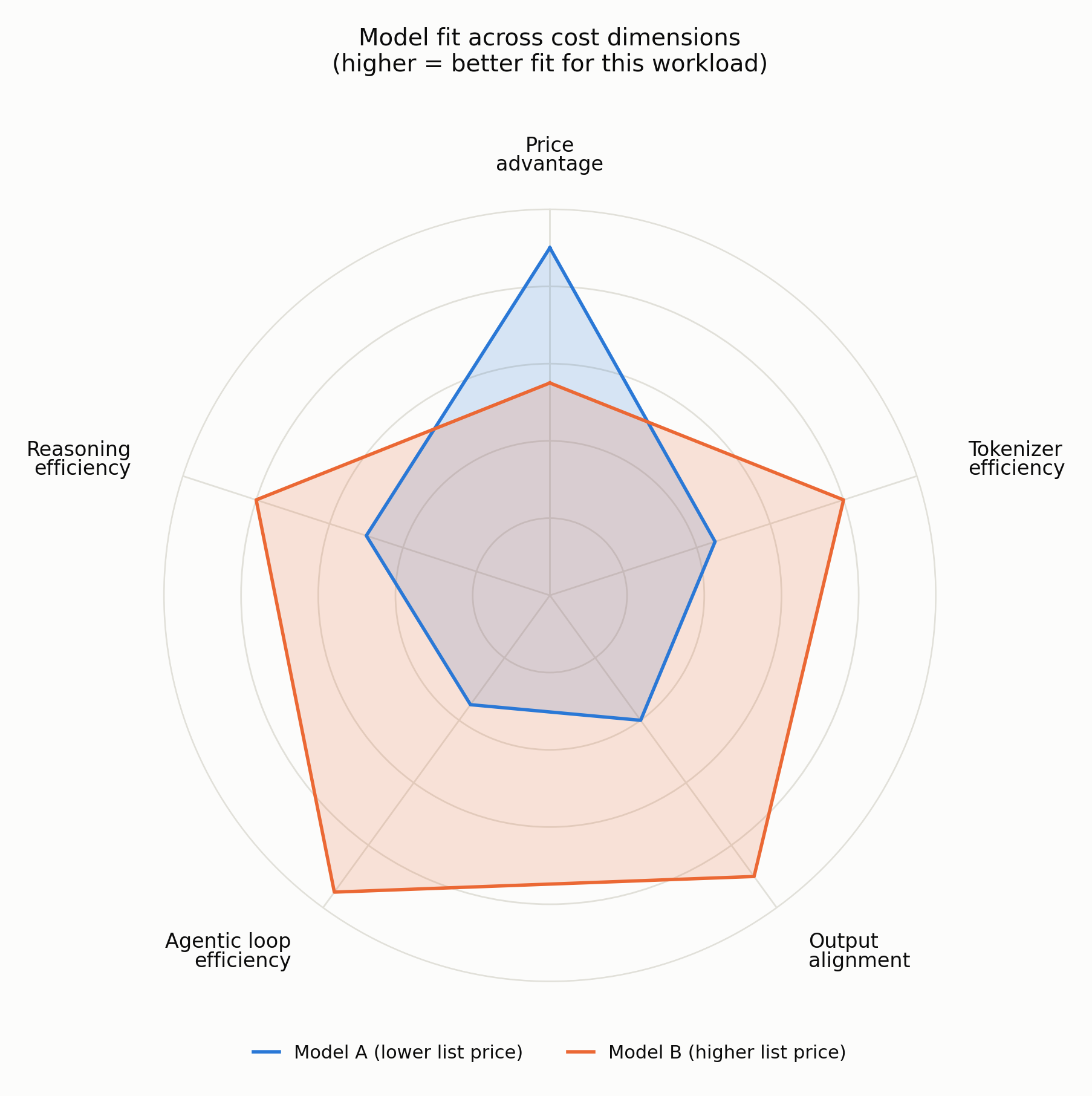
Comparing per-token prices hides the real cost of running a model on Amazon Bedrock. This post shows how to calculate the true cost per task across four hidden cost drivers, reduce it with caching, routing, and output constraints, and prove agent ROI with human baselines, holdout experiments, and a five-dimension scorecard.
Alloop Trio is a shape-shifting health wearable with a tiny sensor, a voice-enabled AI agent, and a few clever ideas about how wearables might be used in the future. Imagine finishing a workout, tapping your wrist, and telling your fitness tracker, “Just finished four sets of bench presses at 150 pounds. Feeling great today.” That’s
Oral exams are compelling because (1) students can be asked to provide their reasoning for an answer and (2) their interactive nature permits follow-up questions to resolve ambiguous answers. But oral exams scale poorly. In this paper, we present scalable conversational assessment, an LLM-based system that conducts interactive text-based conversations with students to assess their ability to make and support an argument. We use a two-agent architecture to separate concerns…
Anthropic has released a self-hosted version of Claude Managed Agents. Companies can run the agent harness, sandboxes, credentials, and session history in their cloud or on-premise. The option opened as a private beta on November 12, and customers request access through their Anthropic account team. The change matters for agents that already work unattended inside corporate systems, fixing broken builds, testing releases, triaging alerts, and working through bug backlogs…
Today, we’re introducing Gemini 4 Hydrogen, our daily driver for agentic workflows
Build faster with Gemini 4 Hydrogen, Google’s new model for cost-efficient agentic coding and debugging. Start building in Google AI Studio today.
AI agents now run multi-step workloads for hours and act on behalf of users, raising the bar for secure, scalable agent compute. Learn how the next generation of Amazon Bedrock AgentCore runtime delivers hardware-isolated sessions with faster starts, more compute, usage-based billing, and isolation that now extends to your data.
Federated learning (FL) enables independent data owners to train models collaboratively without centralizing raw data. However, identifying collaborators, preparing training tasks, and coordinating execution and incentives hinder its practical adoption by organizations without specialized expertise. We present Cortex-FL, an agent-native FL system that enables users to express learning objectives in natural language and delegate the collaboration required to train a model…
Decision models answer a question with a typed output, such as a choice among options with a probability for each, so one model can choose an agent's actions, evaluate actions already taken, or score every action to teach a policy with reinforcement learning. Prior work has studied them mainly as actors, judging their usefulness by how well they act. We ask whether a decision model that acts poorly can still teach well. We compare three decision models and three general LLMs…
Embodied interaction requires an agent to integrate multimodal perception with verbal and nonverbal behaviors to effectively communicate its intentions, including speech, body motion, and facial expressions. We present XBot-Omni, a Thinker--Talker--Actor architecture that extends the Omni paradigm to robotic modalities, including body motion and facial expressions, with ``X'' representing the extensibility to robotic-specific modalities. The Thinker processes text, images…
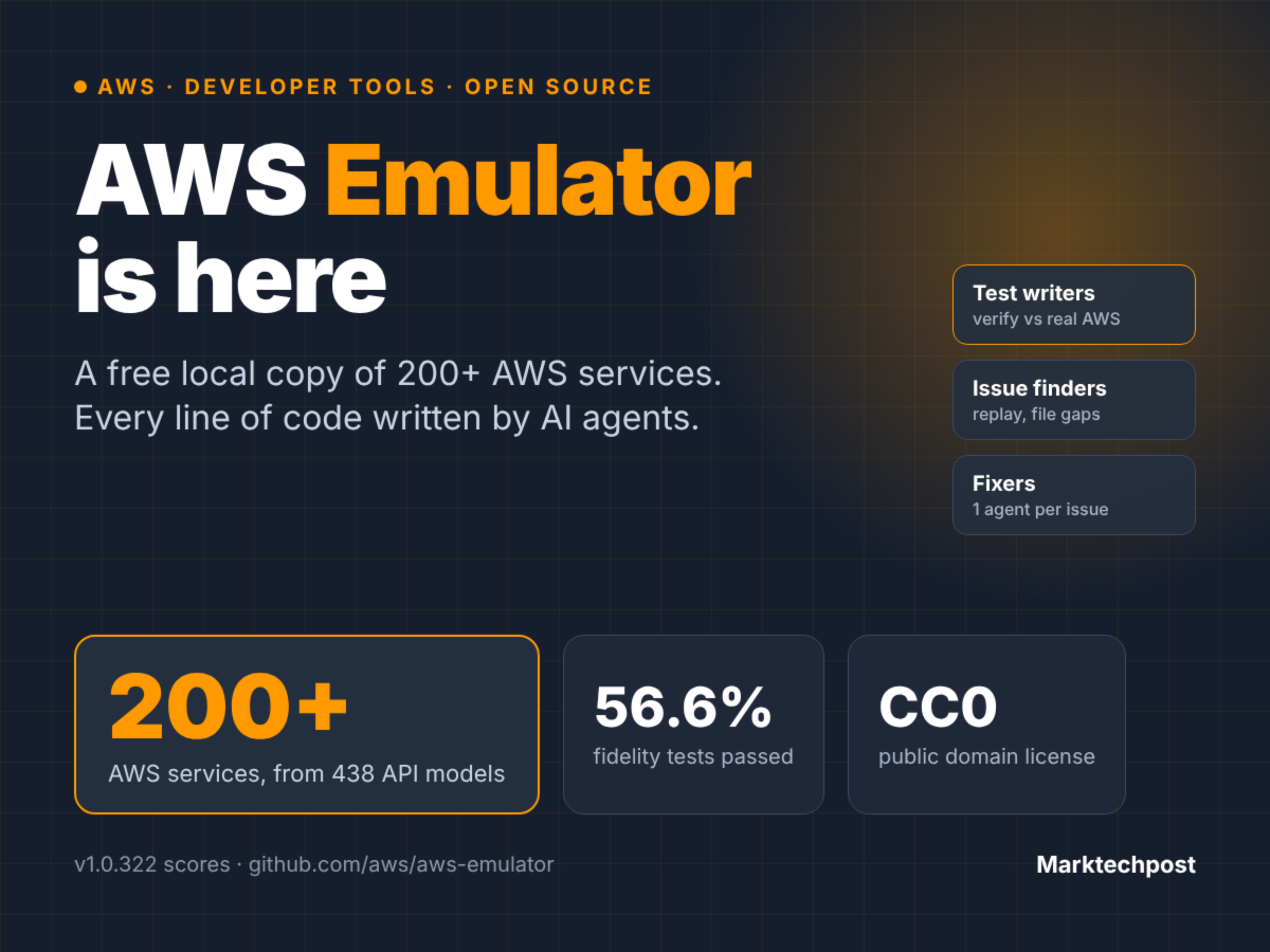
AWS released AWS Emulator, a free, CC0-licensed local emulator of AWS APIs built from 438 API models. Autonomous agents wrote all of its code. It passes 56.6% of 42,857 published fidelity tests at launch.
The airline said it will not allow customers to use AI agents to book flights and manage reservations.
Enforcement defenses against prompt injection, such as CaMeL, Progent, IPIGuard and DRIFT, ask the agent's own model to write a security artifact (a program, a privilege policy, a dependency graph or a constraint list) that code then enforces. We ask whether small language model (SLM) agents can be trusted to write these artifacts. Across 15 open-weight models, 13 of them between 1.7B and 12B parameters, they cannot: the policies, graphs and constraints that the agent's…