Results for “GPU”

arXiv (research papers) Jonathan Pan Security

From Bytes to Behavior: Request-Level Attribution from Live GPU Hidden States

Existing memory forensics for machine learning systems typically targets static artifacts, such as model weights or prompt logs, rather than the transient computational states of a live inference process. This gap limits an examiner's ability to analyze the specific behavior of a running large language model (LLM) service that cannot be restarted or modified. We present a method for acquiring per-layer residual-stream activations from a live GPU process using a non-modifying…

Read at arXiv (research papers)

Quantum Computing Report Mohamed Abdel-Kareem

PsiQuantum and AMD Expand Partnership with Equity Investment to Co-Design Utility-Scale Quantum Infrastructure

PsiQuantum and AMD are expanding their partnership with an equity investment from AMD to co-design the infrastructure for fault-tolerant quantum systems. The collaboration integrates AMD's GPUs, CPUs, and software with PsiQuantum's silicon photonics architecture to enhance real-time error correction and classical computing for hybrid workloads. They are prioritizing pharmaceutical research and molecular simulation, with plans to present further technical details at the SC26…

Read at Quantum Computing Report

TechPowerUp DrUsmanSaleem

AMD Reportedly Cuts Gaming GPU Supply in China by Up to 50%

AMD has reportedly cut its gaming GPU supply in China by at least 20% to 50% since the start of the fourth quarter in October. According to a November 12 post on Board Channels spotted by Videocardz, AMD's shortage is now comparable to NVIDIA's, with very few gaming chips going to add-in board (AIB) partners. Their monthly allocations are apparently still shrinking, and the source expects supply to remain extremely tight until January. The same source describes Radeon prices…

Read at TechPowerUp

arXiv (research papers) Haozhe Wang SI

Metal Sandbox: Isolated Execution and Command Scheduling for GPU Coding Agents on Apple Silicon

On-device inference requires kernels that make effective use of local accelerators. Efficient training and evaluation of models that generate Apple Metal kernels benefit from native macOS tools and concurrent agent sessions. These sessions alternate between model requests, development commands, and GPU execution, leaving GPU capacity idle for much of a rollout. We present Metal Sandbox, infrastructure that combines restricted per-instance file access, native command…

Read at arXiv (research papers)

TechPowerUp Nomad76 SI

(PR) Axelera AI Unveils Titania Architecture

Axelera AI, the leading provider of purpose-built AI hardware acceleration technology, unveiled the details behind Titania, its third-generation silicon architecture in a chiplet design. Titania is highly programmable and energy efficient and will deliver high performance at interactive speeds, all within the power and cooling limits of existing data centers, rather than the 100-kilowatt-plus liquid-cooled racks that today's highest-density GPU systems require. Performance…

Read at TechPowerUp

SANS Internet Storm Center Security

Exploit Attempts for GPUStack Authentication Bypass (CVE-2026-102895), (Thu, Nov 12th)

CVE-2026-102895 is a trivial authentication-bypass vulnerability. GPUStack is also an attractive target. It is open-source software that manages clusters of GPUs, which are typically used to run AI workloads. All versions of GPUStack prior to 2.2.0, which was released at the end of June. This vulnerability was not made public until the end of July, and the CVE was assigned on November 4th.

Read at SANS Internet Storm Center

YourStory Startups

Karnataka open to subsidising GPU access for startups through AI hub

The state could offer support beyond the Centre’s IndiaAI Mission. It is also considering shared manufacturing space for small companies near Bengaluru.

Read at YourStory

Analytics India Magazine Siddharth Jindal SI

Meet Netweb, the Only Indian Company Building NVIDIA-Certified GPU Servers

Netweb is betting on AI infrastructure, with new initiatives spanning agent security, GPU optimisation, and sovereign computing.

Read at Analytics India Magazine

arXiv (research papers) Tim De Wachter Security

Look Here, Then Decide: Small Decision Models in a Harness Find Memory-Safety Vulnerabilities at Scale on Commodity GPUs

We ask whether small, open-weight decision models can support vulnerability discovery in open-source software at scale and what the surrounding system must provide. These models answer a typed question in one forward pass, returning scores for the permitted answers rather than text. Our harness selects widely packaged C and C++ projects and uses deterministic incomplete-fix miners and shape localizers to decide where to look. Intern-Decision-4B, a 4B-parameter open-weight…

Read at arXiv (research papers)

Quantum Computing Report Mohamed Abdel-Kareem

Anyon Technologies and Q-CTRL Partner on Self-Calibrating Hybrid Quantum Supercomputers

Anyon Technologies and Q-CTRL have partnered to create self-calibrating hybrid quantum supercomputers. They are integrating Q-CTRL's autonomous calibration software, Boulder Opal, with Anyon's superconducting quantum computing systems, which use NVIDIA GPUs. This collaboration aims to automate the setup and maintenance of quantum processors, reducing operational costs and making quantum computing more accessible for commercial use by eliminating manual tuning.

Read at Quantum Computing Report

AWS Machine Learning Blog Siddharth Senger SI

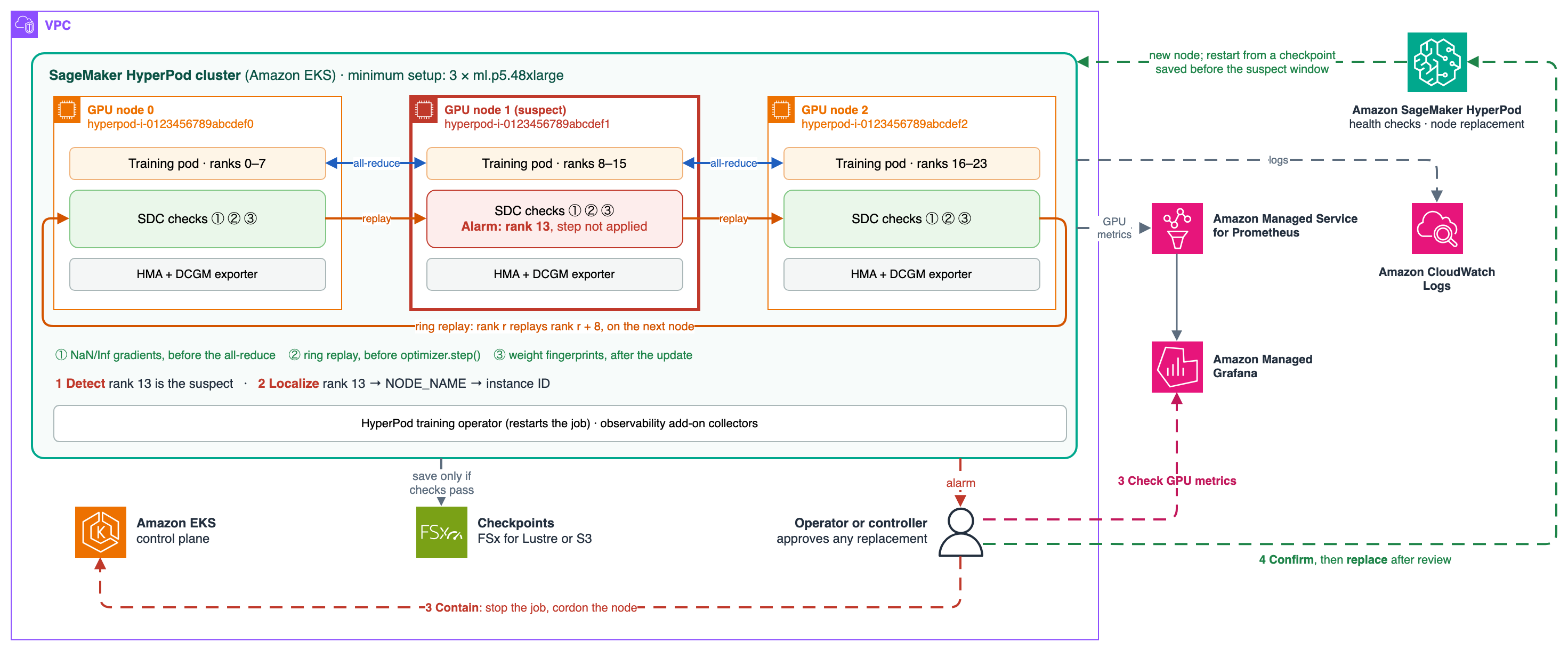
Detecting and recovering from silent data corruption on Amazon SageMaker HyperPod

Silent data corruption is a GPU fault that returns wrong but plausible numbers with no error, quietly poisoning distributed training. This post adds three checks to a PyTorch DDP loop to detect it, localize the faulty node on Amazon SageMaker HyperPod, and hand the node to automatic recovery for replacement.

Read at AWS Machine Learning Blog

arXiv (research papers) Sumanth Gudaparthi

Starscream: Reimagining LLM Sharding on AMD Instinct GPUs with GPU Partitioning

As GPU accelerators grow larger to meet rising compute demands, they exhibit increasingly pronounced non-uniform memory access (NUMA) characteristics that challenge existing LLM frameworks. Chiplet-based architectures provide a practical path to larger GPUs while mitigating manufacturing yield constraints. Modern GPUs such as AMD Instinct MI300X employs such a multi-die design, and further offer GPU partitioning capabilities, partitioning a single physical GPU into multiple…

Read at arXiv (research papers)

The New Stack Sabari Sawant

Expensive accelerators, no workload-level visibility: Introducing Amazon CloudWatch accelerated compute insights

Accelerator bills have become one of the largest lines in the infrastructure budget. GPUs have become the most expensive resource

Read at The New Stack

MarkTechPost Asif Razzaq SI

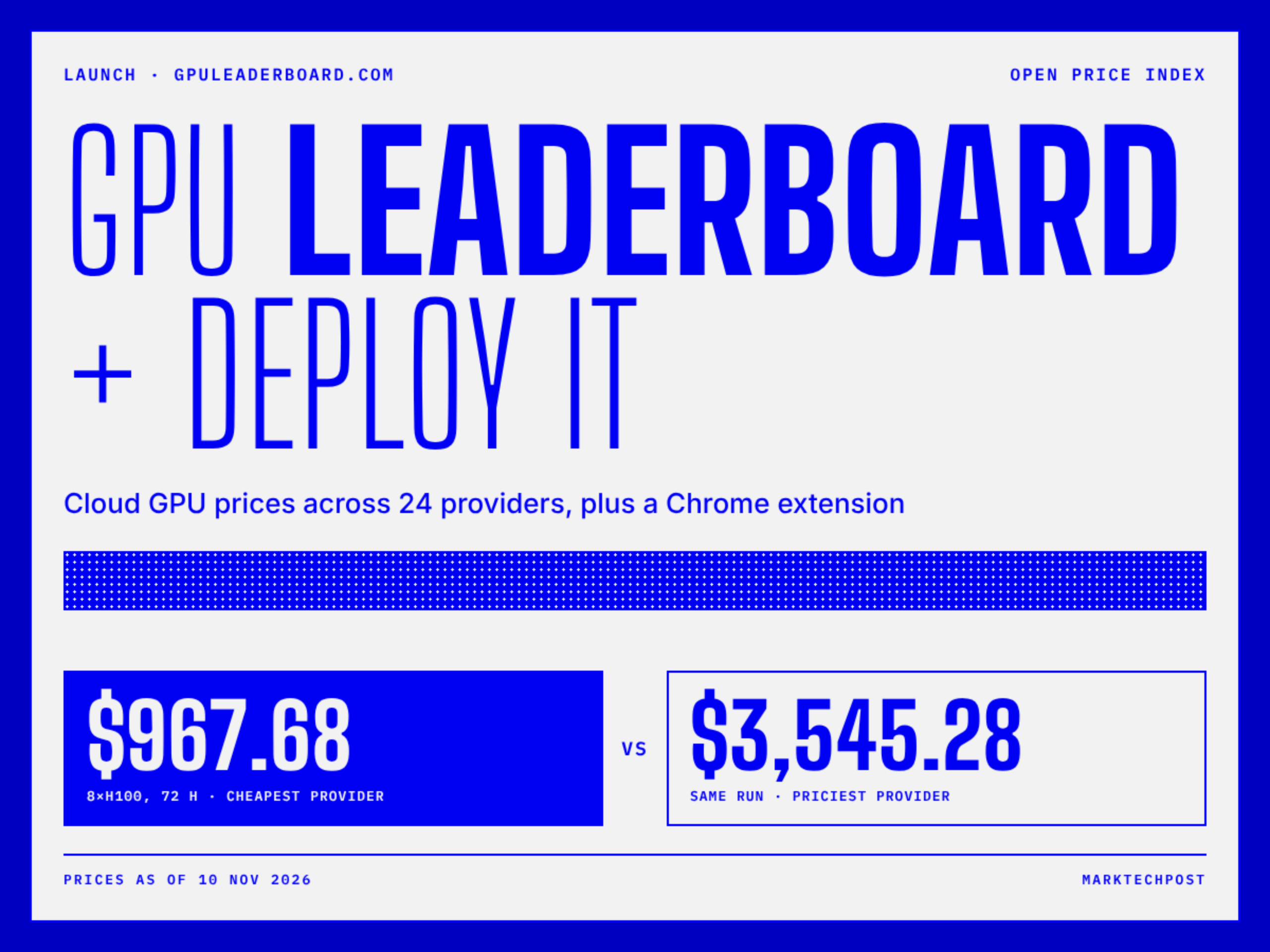
Marktechpost AI Launches GPU Leaderboard and the Deploy It Chrome Extension

Marktechpost Launches GPU Leaderboard and the Deploy It Chrome Extension

Read at MarkTechPost

Simon Willison SI

Anthropic's IPO roadshow video

Anthropic's IPO roadshow video Anthropic kicked off their IPO roadshow yesterday, and their roadshow video has some previously unreleased information about how their business works. The section on "Approach to compute" with co-founder Tom Brown is particularly interesting, describing how Anthropic train and serve Claude across AWS Trainium, Google TPUs, NVIDIA GPUs, and AMD GPUs. I'm not sure why there's no official video transcript, but here's one that I extracted using…

Read at Simon Willison

The Decoder Matthias Bastian SI

Anthropic says AI is eroding Nvidia's CUDA lead, cutting an AMD chip switch from months to three days

Anthropic claims it used AI itself to breach Nvidia's CUDA moat. The company's in-house model Mythos reportedly ported Claude to AMD GPUs in just three days, with almost no human intervention. Anthropic now runs Claude on four chip families and aims to cut costs and reduce vendor dependencies. The article Anthropic says AI is eroding Nvidia's CUDA lead, cutting an AMD chip switch from months to three days appeared first on The Decoder.

Read at The Decoder

arXiv (research papers) Zahraa Selim SI

Edge-Native Multimodal RAG: Hardware-Aware Quantization and Architectural Optimization for Consumer GPUs

Deployment of retrieval-augmented generation (RAG) for Edge-AI is constrained by memory and bandwidth limitations. A standard 7B parameter model consumes 14 GB Video Random Access Memory (VRAM) in half-precision (FP16), precluding co-location of vector indices and Key-Value (KV) caches. This paper presents an engineering integration and empirical evaluation of a multimodal RAG framework optimized for consumer-grade Turing hardware (e.g., NVIDIA Tesla T4). Our system-level…

Read at arXiv (research papers)

arXiv (research papers) Nhut-Minh Ho Security

CuEVM: Scaling Smart Contract Execution on GPUs

Smart contracts on Ethereum blockchain process transactions worth billions of US dollars daily. They run on top of Ethereum Virtual Machine (EVM) which executes transactions sequentially. This execution model creates a performance bottleneck, especially for new blockchain workloads with large numbers of transactions, such as security testing. We present CuEVM, a GPU-native and semantically complete EVM execution engine that treats transaction execution as a massively…

Read at arXiv (research papers)

MarkTechPost Michal Sutter SI

Meta FAIR Releases e-means: An Algorithm Beating k-means in 10x Fewer Epochs

Meta FAIR’s e-means is a mini-batch k-means replacement shipped in FAISS 1.16.0. It reaches Lloyd’s 25-epoch loss in 1.4 to 2.6 epochs, with 10-45x GPU speedups and no extra hyperparameters.

Read at MarkTechPost

arXiv (research papers) Anish Saxena

SlipStream: Enabling HBF for GPU Systems by Mitigating the Latency and SRAM Overheads

Large language model (LLM) inference demands ever more memory capacity for larger models and batch sizes. High-Bandwidth Flash (HBF) replaces the DRAM dies of HBM with NAND flash and provides up to 16x the capacity at comparable read bandwidth. However, HBF can incur a read latency of nearly 20$μ$s, 20x that of HBM, so on-demand HBF accesses slow inference by up to 12.8x. Conventional cache-line prefetchers require 20x more in-flight tracking state to cover this latency…

Read at arXiv (research papers)

TechPowerUp Nomad76 SI

(PR) MSI Advances Next-Gen Data Center Infrastructure with AMD EPYC 9006 Series Server CPUs

As agentic AI drives new demands for compute density, memory bandwidth, and data movement, MSI is advancing next-generation data center infrastructure with server platforms powered by AMD EPYC 9006 Series SP7 Server CPUs. With SP7 systems entering the shipping phase in Q4 2026 and SP8 platforms planned for the first half of 2027, MSI's portfolio spans liquid-cooled GPU servers, 19" DC-MHS and 21" ORv3 multi-node platforms, and enterprise servers, supporting AI, cloud, HPC…

Read at TechPowerUp

TechPowerUp DrUsmanSaleem

Microsoft Developer Builds a GPU Task Manager to Show Which Apps Are Eating Your VRAM

Anyone wondering what is filling up their GPU's VRAM can now try gputaskman, a free, open-source tool from Microsoft VP Scott Hanselman. It runs in a terminal window with an htop-style layout and lists every process using the GPU with its memory footprint, engine activity, and loaded runtime, such as CUDA or Vulkan. A panel up top tracks utilization, clocks, temperature, and power. Hanselman shared the project on X last week and asked for pull requests. Task Manager has…

Read at TechPowerUp

Quantum Computing Report Mohamed Abdel-Kareem

Quantinuum, RIKEN, and SoftBank Partner to Advance Quantum-AI Supercomputing and Domestic Fault-Tolerant Systems

Quantinuum, RIKEN, and SoftBank have partnered to advance quantum-AI supercomputing and develop fault-tolerant systems in Japan. This collaboration involves commercializing hybrid quantum-AI supercomputing using Quantinuum's Reimei H2 quantum computer, RIKEN's ROQUO GPU system, and Supercomputer Fugaku. The partnership also aims to create a "Made with Japan" fault-tolerant quantum computer and integrate quantum hardware with commercial AI data centers through SoftBank.

Read at Quantum Computing Report

TechPowerUp TheLostSwede SI

(PR) Gigabyte Launches the AI TOP AERO Powered by NVIDIA RTX Spark

Gigabyte today announced the launch of AI TOP AERO, a new AI desktop powered by the NVIDIA RTX Spark platform. Positioned as a Personal AI Studio, AI TOP AERO combines an NVIDIA Blackwell architecture GPU, up to 128 GB of unified system memory, and Gigabyte's cooling and compact chassis design. The new desktop expands Gigabyte's AI PC lineup, bringing local AI development, content creation and gaming to personal workspaces. NVIDIA RTX Spark unites NVIDIA AI, RTX graphics…

Read at TechPowerUp

arXiv (research papers) Tomer Solberg Security

Sable: A Small-Field Sumcheck Argument for Bit-Exact Inference of Large Language Models

We present Sable, an argument system and single-GPU prover for the statement that a committed, integer-quantized transformer produced a given token sequence from a given prompt, bit for bit. Sable fixes an integer function F_O with no floating-point step, in which every rounding, normalization, softmax and sampling decision is determined by its inputs, and proves it with a constraint system whose relations provably never wrap modulo the 31-bit KoalaBear prime. The proof…

Read at arXiv (research papers)

arXiv (research papers) Haozhi Xie

SFU-Sim: Bit-Exact Reverse Engineering of NVIDIA MUFU and Validation of PTX Paths

Reproducing the numerical behavior of a GPU requires predicting the exact output of special function instructions. Vendor documents give only the function semantics and error bounds. These do not fix the output bit pattern. We present SFU-Sim, which builds bit-exact models of NVIDIA multi-function unit (MUFU) instructions by black-box reverse engineering on real GPUs. We first model a single bare MUFU instruction. We then add the surrounding operations found in the…

Read at arXiv (research papers)

arXiv (research papers) Ziwen Wang

Uncovering the Memory Hierarchy of Modern NVIDIA GPUs for Accurate Simulation

Emerging artificial intelligence workloads, particularly Large Language Models (LLMs), place unprecedented demands on GPU memory systems. Consequently, architectural innovations increasingly target the memory system to alleviate these bottlenecks. However, existing works still rely on outdated memory hierarchy models that fail to capture the complexities of modern hardware. This fidelity gap leads to inaccurate characterization and could misguide optimization strategies. To…

Read at arXiv (research papers)

arXiv (research papers) Qi Luo

Scaling Shapley Energy Attribution to Large LLM Batches

LLM services have become essential infrastructure for applications such as chat assistants and coding agents. Service providers need to attribute resource consumption to individual requests for purposes such as billing. Among these resources, energy is a key metric for assessing the cost of serving each request. However, serving engines batch requests together, and GPUs report only aggregate energy consumption. Providers typically estimate each request's share in proportion…

Read at arXiv (research papers)

arXiv (research papers) Ziwen Wang

Exploiting What NVIDIA Profilers Hide: Fast and Accurate Analytical GPU Performance Modeling

GPUs have become essential to many fields, including AI and scientific computing. As GPUs grow more complex, the design space of their hardware configurations becomes increasingly large, yet cycle-level simulators remain too slow to explore it. Analytical models make this exploration much faster. However, existing GPU analytical models fall short of accurately predicting performance across hardware configurations, because they re-estimate or scale every stall of a warp on…

Read at arXiv (research papers)

Older stories