In this commentary, Professor Ibrahim Ozturk examines the political economy of artificial intelligence (AI), highlighting its productive potential alongside
By Tim Worstall Professor Mazzucato tells us that much, much, more should be within the state. Professor Weber tells us that anti-fascist economics should be done by utilising the fascist economic tactics of a nominal market based capitalism but with the state setting all the prices. Given this revival of century old policies perhaps we could run with another one? Bristol could become home to the UK’s first “wetland city” thanks to a charity’s efforts to create vast wildlife…
An excerpt from Isabella Weber’s new book Anti-Fascist Economics. For decades, mainstream economics has diverted attention away from the problems it cannot solve—even a problem as fundamental as survival. In the 1950s, economists researching general equilibrium theory set out to demonstrate that decentralized market decisions, guided only by prices, would lead to a “Pareto optimal”
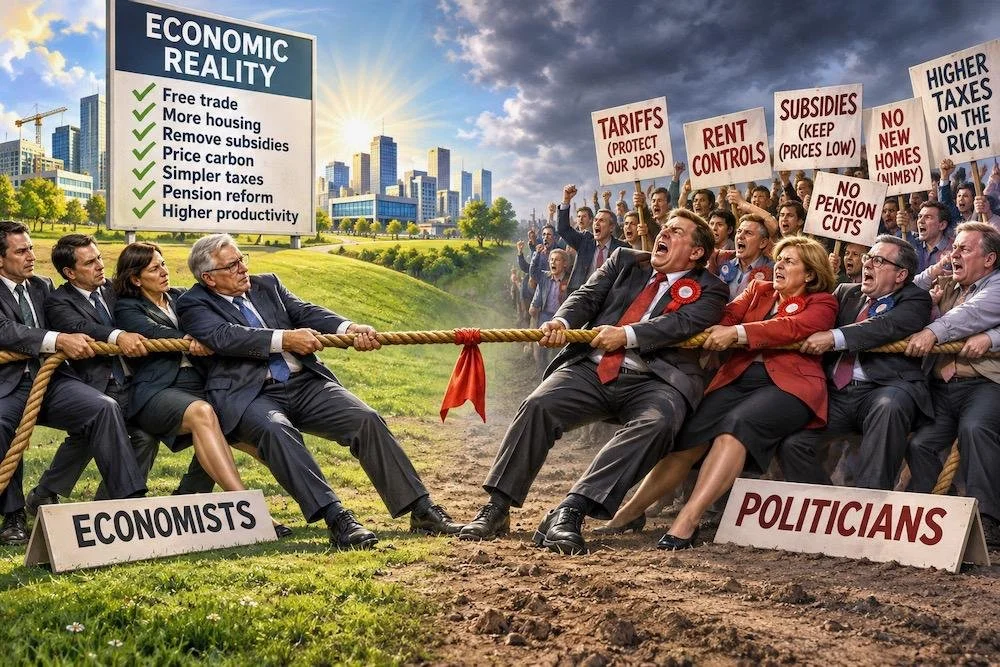
There are many real-world examples where economic logic runs into political walls. These are cases where sound economic decisions are hard to implement because of political resistance, short-term thinking, or public perceptions. The one most currently in the public eye is between free trade and protectionism. Economists from Adam Smith onwards have known that free trade leads to growth and prosperity. Public perception, unfortunately, is that cheap imports threaten local…
By Tim Worstall It’s not necessary to travel far - the opinion pages of The Guardian for example - to find people whining that economic growth just isn’t the thing. We need to concentrate upon the wider picture, leisure, externalities, the real and proper measures of consumption. Thus all conventional - for which read market, capitalist, non-socialist even - economics has to be disposed of. Well, yes: A major question raised by critics of economic growth is whether we have…
I suppose property professors are always on the lookout for unconventional uses of land. My work examines the transformation of various cities under financial capitalism. City governments regulate land to attract real estate investors just as they make governance decisions as if they were financial actors and not representatives of the public. I’ve argued that investors and their partner real estate developers exercise agency in the city. This has left cities less prone to…
As the lament swells around democratic crisis and the rise of the right, with populist moped-riders sweeping elections and traditional political parties left “shocked”, attention increasingly turns to the actual processes and spaces of political deliberation and their corrosion through social media and artificial intelligence (AI). Contentions around “too much screen time”, however, fall short of addressing both the significant place that social media holds in…
This article develops a Marxist account of the US attention economy through Donald Trump’s media presence. It argues that Trump operates as a “volatility asset” within platform capitalism, a figure valued for producing rapid spikes and crashes of attention that can be converted into advertising inventory and behavioural data. Bringing Marx’s commodity analysis into dialogue with Smythe’s audience commodity, communicative capitalism, surveillance capitalism and data…
This article critically reconstructs the law of the tendential fall of the rate of profit, as formulated by Marx in Volume III of Capital , as a concrete expression of the intrinsic dynamic of developed capitalism. It argues that this tendency operates as a two-sided law that simultaneously entails a falling rate of profit and an increasing absolute mass of surplus value, which makes it irreducible to a linear process of systemic collapse. Drawing on a reading that…
ABSTRACT This article develops the concept of the “immigrant question” to account for the social tensions surrounding immigrants and their descendants in contemporary France, and, more broadly, to shed light on the transformation of the French polity in the context of changing capitalist social relations. Rather than locating these tensions primarily in the politico‐legal features of French republicanism or in cultural and identity‐based explanations, it argues that they…
This study examines the intersection of literature, socio-economic critique, and digital activism through Facebook poetry by Nigerian poets Tauchee Udogu and Kingdom Nta. Using Marxist theory as the primary analytical lens, supported by insights from segmented labour market theories and institutional economics, the study investigates how poetry reflects and critiques systemic inequalities in Nigeria. Analysis of three selected poems reveals how language, through lexical…
No, we do not know why Poundland is in financial difficulties. Further, the why is not important to this next point. The very point - the thing it does so well - of free market capitalism is to clear up messes like Poundland: Protect Poundland from predatory capitalism, MPs tell government That predatory capitalism is the solution here, not the problem. MPs have called on the government to protect Poundland and other high street stores from “predatory capitalism” and…
Using questionnaire data collected in 2019, this study examines how preparation conditions relate to perceived government financial reporting quality (GFRQ) in the first year of China’s new government accounting system. The multilevel socio-technical systems (MSTS) framework distinguishes departmental reporting as an operational layer and consolidated reporting as an integration layer. Separate respondent-level regressions use 5157 departmental and 672 consolidated…
The transmission of US financial stress to emerging markets is a key issue in a global environment characterized by the COVID-19 pandemic, monetary tightening, geopolitical tensions, and disruptions in commodity markets. This study aims to analyze the non-linear transmission of US financial stress to the stock markets of the BRIC countries (Brazil, Russia, India and China) and to examine whether this stress increases the probability of regime shifts in the volatility of…
Feeding humanity without destroying the planet is recognized as one of the key challenges of our age. A related challenge—feeding the planet without unleashing political dynamics that foster violent, exploitative and authoritarian tendencies—has received less attention. Yet, at least in some South American countries, these challenges are closely intertwined. The Bolivian case is illustrative in
Since the Asian financial crisis, major Indonesian conglomerates have increasingly reorganised accumulation across national boundaries through foreign production, acquisitions, joint ventures and regional corporate networks. Nevertheless, such internationalisation poses a political and commercial problem: how does capital historically constituted through concentrated ownership and privileged relations with state power reproduce itself across different political economies?…
Biological evolution, scientific progress and the market economy run on the same engine. Something new is tried. Most attempts fail. The few that survive are kept and built upon. Genes, theories and businesses all advance this way, by trial and the elimination of error. The obvious objection is that nature is random while science and commerce are purposive. Mutations happen by accident. Scientists and entrepreneurs act by design. Surely that changes everything? It changes…
China’s publicly listed infrastructure REITs (C-REITs), launched in 2021, represent an important innovation in infrastructure finance and capital market reform. Their emergence raises important questions about the changing relationship between the state, market creation, and infrastructure financialization in China. Existing studies have variously interpreted C-REITs as an extension of state capitalism, an expression of state entrepreneurialism, or evidence of growing…
This paper studies regulatory compliance and financial regulation issues in cross-border financial data flows under the new circumstances of increased application of artificial intelligence (AI), cloud computing and data-intensive analysis in finance. Although it does not provide new empirical data, cross-border financial data activities can be viewed in light of data protection, trade in services, prudential supervision, digital operational resilience and internal…
The latest, in The Guardian (and read on for the Adam Smith Institute's miffed response): "As the radical economists Fred Magdoff and John Bellamy Foster show in their new book, Grand Theft Capital: What Workers Should Know About the Affordability Crisis, the share of national income going to ordinary workers has slumped from 30% in the 1960s to 20% today. This is the destruction of working-class lives and dreams in which Republicans and Democrats colluded. This is the…
Abstract Within the framework of Marxist political economy, and through an analysis of state power, military structures, and international relations, this article argues that crony capitalism, as a politico-economic model in which wealth accumulation and resource allocation are highly dependent on political power, represents an alienated and distorted form of contemporary capitalism under specific historical conditions. In contexts where political systems remain…
ABSTRACT State platform capitalism and China's digital exports are frequently viewed as geopolitical frameworks, emphasizing zero‐sum competition and structural dominance. This paper challenges such conceptualizations by investigating the market‐making capabilities of transnational technology firms and the strategic agency of host countries. Focusing on Alibaba's expansion into Indonesia, we argue that Chinese digital exports and the Digital Silk Road are better understood…
Purpose This paper aims to examine how China’s A-share market responds to dividend and share-repurchase announcements, interpreting payout policies as mechanisms of financialisation and surplus distribution rather than purely informational signals about firm fundamentals. Design/methodology/approach The study applies an event-study methodology using the market-model CAPM to estimate abnormal returns surrounding payout announcements. Normal returns are estimated over a…
Will you be in Amsterdam on November 23rd? Head to the social center known as Pakuis de Zwijger for a lively and engaging event with Chris dePloeg together with renowned climate author Jason Hickel (in person), frontline Palestinian surgeon Ghassan Abu-Sittah (joining online) and moderator, climate justice activist and researcher Harriët Bergman. There will also be cultural performances from Chihiro Geuzebroek and brothers Chris and Max de Ploeg, tying their ancestral…
Just released! The new, expanded Italian edition (featuring an afterword by Riccardo Bellofiore) of Amos Cecchi's book on the economic thought of Paul M. Sweezy.
Lawful cultural extraction may leave chokepoints intact while making them harder to see. This article examines that risk in European Union copyright and AI governance. Combining doctrinal legal analysis with legal political economy, it applies Giblin and Doctorow’s account of chokepoint capitalism to cultural inputs and AI-generated outputs, distinguishing barriers, practical dependency, intermediary control and capture. The analysis identifies how rights reservations…