Microsoft unveils AI models for coding, cybersecurity
Microsoft calls MAI a 'hill-climbing' effort, with models linked to GitHub Copilot and Excel.
Microsoft calls MAI a 'hill-climbing' effort, with models linked to GitHub Copilot and Excel.
Ising machines, dedicated accelerators built around the dynamics of Ising-like spin models, have emerged as a leading platform for combinatorial optimization and probabilistic sampling. The problems that motivate them require millions of spins, far beyond the on-chip capacity of any single device, so a practical Ising machine must distribute its computation across many devices. Prior work reports throughput at a single operating point, leaving the binding resource…
A more flexible training method can make AI text detectors more robust when new models emerge or AI-generated text is disguised to appear human.
Vision-Language-Action (VLA) models have emerged as a promising paradigm for general-purpose robotic manipulation, yet their performance often degrades on long-horizon tasks that require multiple interdependent manipulations. Instead of burdening the VLA policies with long-horizon reasoning, memory, action generation, progress tracking, and error recovery, we argue for leveraging their short-horizon manipulation capabilities within an execution-aware framework. To this end…
Mixture-of-Experts (MoE) architectures enable high-capacity large language models (LLMs) with high sparse computation, making them attractive for deployment on private hardware. However, distributing model weights exposes valuable intellectual property (IP) to leakage and unauthorized redistribution, creating an urgent need to both verify model ownership and trace leaked copies to individual licensees. Existing model-watermarking techniques are ill-suited for meeting this…
General robot manipulation requires both semantic competence and physical foresight. World action models (WAMs) acquire an understanding of and predictive capability over the physical world by jointly modeling visual foresight and action distributions. However, existing WAMs still lack semantic competence: they have limited ability to perform open-world scene understanding, semantic reasoning, and long-horizon planning. Although vision-language models (VLMs) provide these…
Vision Transformers (ViTs) now underpin the visual encoders of most multimodal models, but this success comes at a cost: relying on third-party pretrained checkpoints leaves these systems open to backdoor attacks. Existing test-time detection methods rely on either the predicted label or intermediate embeddings, limiting their applicability across diverse tasks and incurring substantial computational overhead. In this work, we study how backdoor triggers affect the…
Tile drainage fundamentally alters how water moves through agricultural fields, affecting surface ponding, water-table dynamics, crop growth, nutrient transport and water quality. Yet fields with similar drainage systems can respond differently depending on soil, topography and tile design—differences that most models struggle to resolve at the field scale.
When humans learn to manipulate an unfamiliar object, they may already be able to anticipate how its state will change while still being unable to control it skillfully. This gap between prediction and control motivates us to study how the priors acquired by video generation models can be used effectively by an action policy. We present ZERITH V2.5, a video-action model (VAM) in which the action policy reads intermediate features of a video generation model, and use it to…
The 5 millionth visitor arrived on the premium cruise ship Celebrity Millennium from Hong Kong (China), carrying more than 2,000 passengers and crew. Quang Ninh pushes pilot socialist hospital, school models Quang Ninh welcomes 5 millionth foreign visitor Quang Ninh explores cooperation opportunities with Indonesia
The 5 millionth visitor arrived on the premium cruise ship Celebrity Millennium from Hong Kong (China), carrying more than 2,000 passengers and crew. Quang Ninh pushes pilot socialist hospital, school models Quang Ninh welcomes 5 millionth foreign visitor Quang Ninh explores cooperation opportunities with Indonesia
Rule-based access control models such as attribute-based access control support flexible policies based on rules with conditional expressions. The design choices in those models such as what is allowed in the conditional expressions or supporting deny rules may impact the range of the policies that are expressible. In this paper, we propose a systematic approach to investigate the semantics and compare the expressiveness of various rule-based access control models that can…
Genesis said it trained its models on sensor data collected from more than 100 workers.
Once deployed on vehicles, end-to-end driving models continuously encounter challenging scenarios, generating valuable human takeover data that capture both model outputs and human behaviors. However, human interventions are often imperfect, as drivers may intervene too late or unnecessarily. Consequently, direct imitation can reinforce late responses or discourage otherwise appropriate maneuvers. To address this challenge, we propose an offline post-training framework that…
IQM Researchers have successfully benchmarked projected quantum kernels across 45 qubits using a cross-device referee-challenger protocol, demonstrating a significant advantage over classical models in quantum machine learning tasks. Their study, conducted on IQM Emerald and Garnet processors, highlights the effectiveness of adaptive Pauli twirling in mitigating errors and achieving near noise-free accuracy. The findings suggest a promising path for quantum advantage in 2D…
Vision-Language-Action (VLA) models have become a powerful paradigm for robotic manipulation and show strong promise for real-world deployment, making adversarial robustness critical for reliable robot operation. Existing adversarial attacks on VLA-controlled robots mainly optimize prediction-level discrepancies or rollout-level deviations to disrupt manipulation. However, they rarely account for the fact that VLA-predicted commands are not executed directly, but must be…
The administration has been seeking to ban U.S. imports of new models of Chinese optical transceivers over national security concerns.
A latent safety filter decides from the latent of a world model whether a planned action is safe. Conformal calibration sets the threshold of the filter so that it accepts an unsafe action only with a small probability. However, the filter can still be conservative and refuse many safe actions, depending on the latent. To measure the conservatism that a latent forces on the filter, we group similar latents and actions into cells. A filter that gives one decision per cell can…
Phishing remains a major source of credential theft and fraudulent payments, and email security systems must classify large message volumes reliably, quickly, and at manageable cost. Large Language Models (LLMs) offer flexible text understanding, but their token-based generation increases response time and API cost, and the reliability of their confidence values requires measurement. Jev 1.13, a typed decision model from TypeSafe AI, instead returns a structured outcome with…
Vision-Language-Action models have demonstrated strong manipulation capabilities. A limitation of VLA models is that most manipulation datasets focus on parallel-jaw gripper systems, making transfer to multi-finger hands challenging, particularly as teleoperation datasets are harder to collect with multi-fingered robots. In this work, we study how to best adapt VLAs to dexterous hands by pairing supervised fine-tuning (SFT) with diffusion-steering reinforcement learning…
The Mars Atmosphere-Ice Coupler MAIC-2 is a computationally efficient, zonally-averaged model designed to simulate Martian surface temperature, atmospheric water transport and surface glaciation over timescales of 10^5 to 10^7 years. While sophisticated General Circulation Models (GCMs) provide high-resolution simulations of the Martian atmosphere, their high computational cost makes them largely unsuitable for studies covering millions of years of orbital evolution. MAIC-2…
Generative AI is increasingly used to assist with data science tasks, yet fundamental questions remain about its ability to correctly formulate analytical problems. We investigate how well large language models (LLMs) can formulate prediction problems when developing models for high-stakes decision making. We focus on one particular challenge to validity: decision dependency, which arises when historical decisions affect observed outcomes. We evaluate this aspect of problem…
OpenAI models optimized circuits used in Jalapeño silicon and improved RISC‑V core designs, showing progress in AI-assisted chip design with GPT‑6 Astra.
Noise steering improves pretrained generative robot policies by learning to select their initial noise without updating model weights. We find that actions in the evaluated world-action models are more sensitive to video noise than action noise, making video noise an expressive input for steering. However, the noise-steering methods we evaluate, in their published forms, struggle to scale to the high-dimensional noise inputs of large policy classes such as world-action…
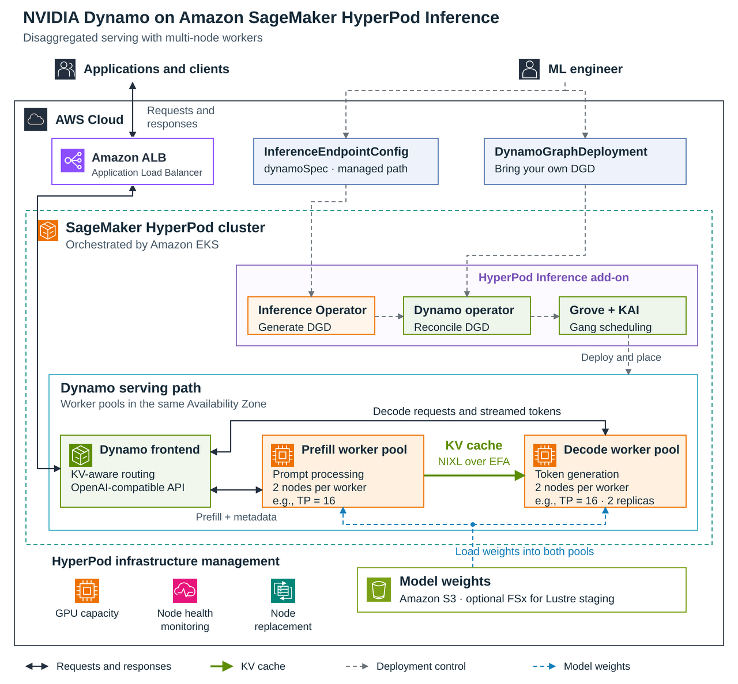
Amazon SageMaker HyperPod Inference now supports NVIDIA Dynamo for distributed inference, with multi-node and disaggregated serving, KV-aware routing, and automatic fault recovery. Serve large models across many nodes without building the orchestration layer yourself.
A frozen latent world model combined with sampling-based model predictive control is a visual planner. At deployment, the executed action can depart from the commanded one, and the frozen model has no way to notice. We show that the model can be run in reverse: for any hypothesized actuation shift, it predicts what it should have observed under that shift, and comparing this prediction with what was actually observed quantifies the shift and lets the planner correct itself…
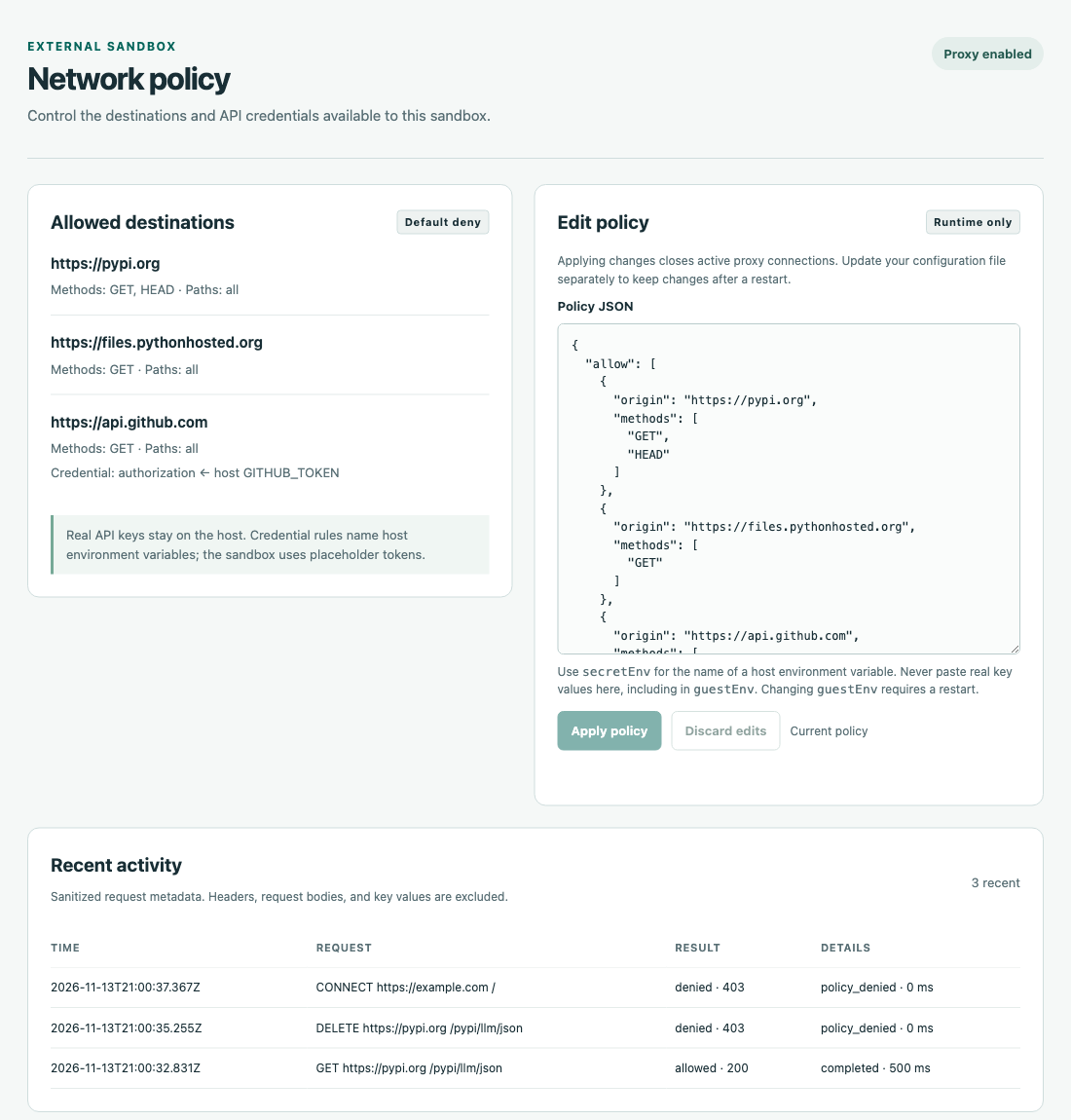
External sandboxes for coding agents I've been exploring new ways to sandbox code that is executed by agents, with a focus on making it safer to try out local models without worrying that a mistake or prompt injection attack might cause them to take damaging actions on a machine. I worked on this project with Prime Radiant, the AI research lab behind Superpowers and other projects. My post on the Prime Radiant blog introduces the external sandbox pattern, where code executed…
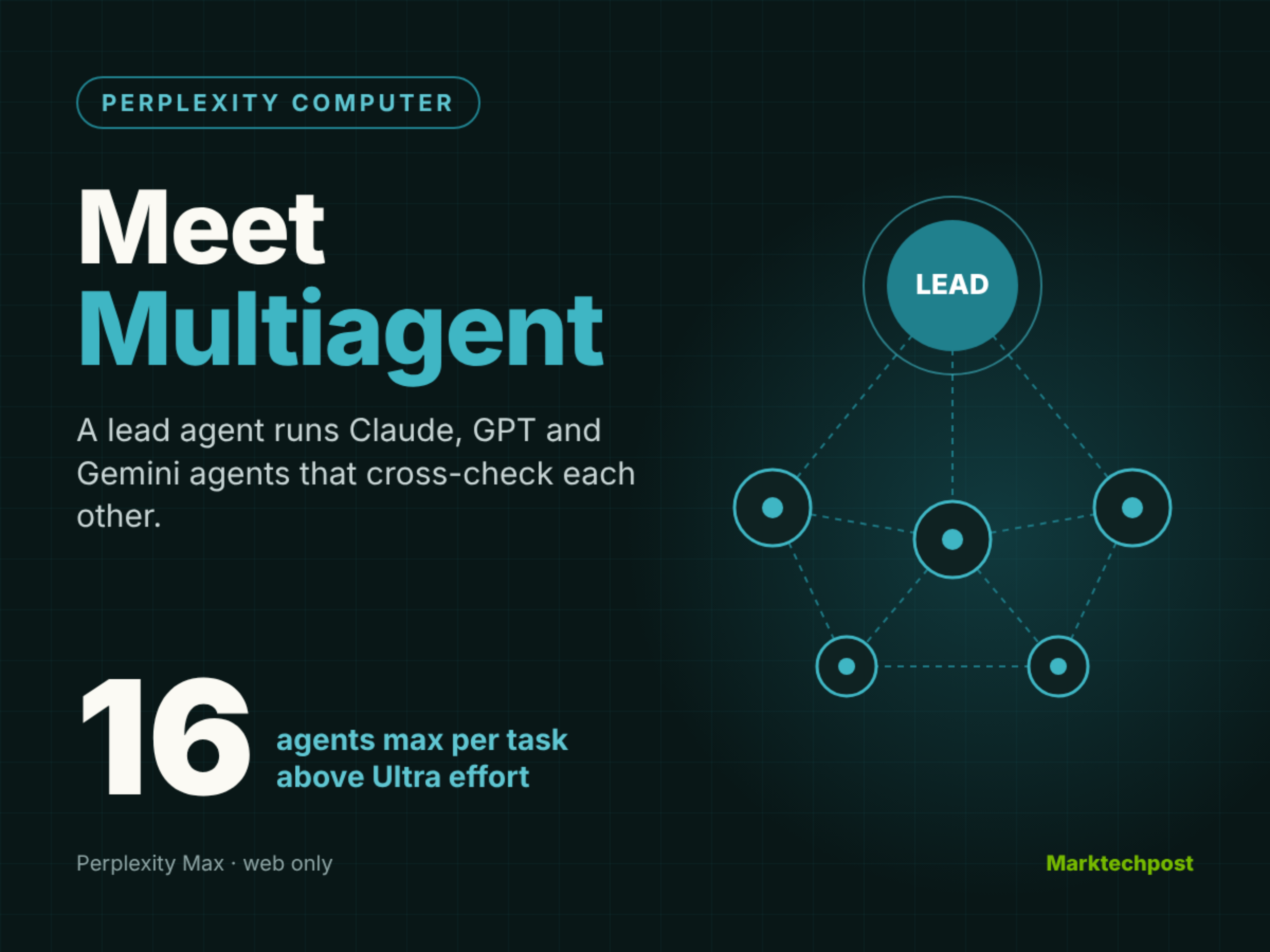
Perplexity added Multiagent to Computer, an effort level above Ultra where a lead agent runs up to 16 agents on Claude, GPT and Gemini models that share findings and check each other’s work.
Microsoft announced two new AI models at Ignite 2026 that promise impressive performance for much lower cost. They could reshape its relationship with OpenAI and Anthropic for good.
Safety certification in robotics typically rests on forward invariance of the deployed controller, a property that demands high-fidelity models at the edge of the operating envelope, exactly where models are least reliable and robots perform best. As a result, many of the behaviors we most want robots to run, from learned policies to aggressive maneuvers at the limits of traction, cannot be certified at all. We introduce recoverability, a contraction-theoretic safety concept…